Emerging Drone Technology for Noxious Weeds Management
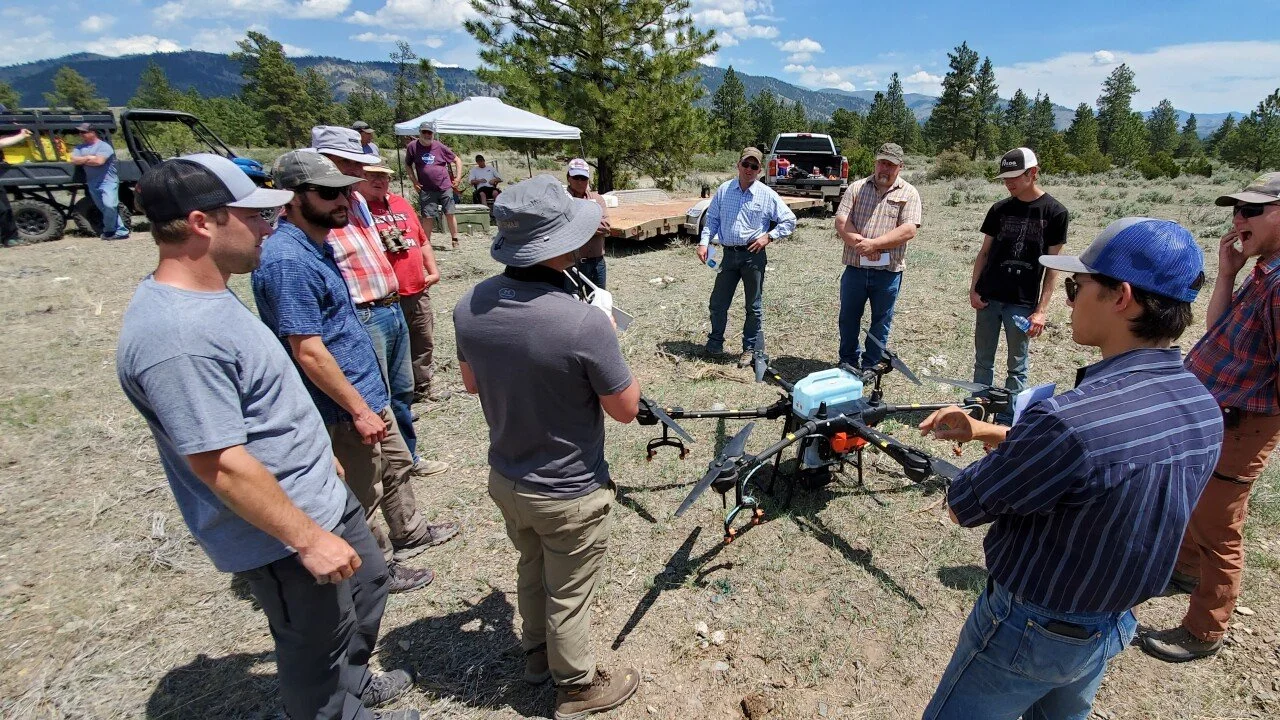
Drone Applicator Licensing Training
Written By: Clayton Marxer, Madison County Weed District Coordinator
(406) 842-5741
clayton.marxer@madisoncountymt.gov
Drones are rapidly becoming a practical tool in the management of noxious weeds across the West. Drone technology has evolved into a highly capable system for mapping, monitoring, treating infestations, and even broadcast seeding. For landowners, county agencies, and contractors in Madison County, these advancements are beginning to offer real advantages in both efficiency and precision.
At their core, modern agricultural drones combine manual or GPS-guided flight with high-resolution imaging and targeted application systems. Mapping drones can survey large areas quickly, producing detailed imagery that helps identify weed infestations—often even specific plants can be identified and mapped. Using software, these images can be processed into maps that highlight problem areas, allowing managers to prioritize and target treatment to where it is most needed.
The next advancement is direct application. Spray drones can carry and apply herbicides with high precision, minimizing off-target impacts. They are particularly effective in rough terrain, sensitive habitats, and hard-to-access or hazardous areas, allowing treatment of steep slopes, riparian zones, and scattered infestations without heavy equipment or labor-intensive backpack spraying, often in a fraction of the time. Drones can also operate in terrain too dangerous for helicopters and can be outfitted for broadcast seeding in revegetation efforts.
There are clear benefits to this approach of using drones as a tool for managing noxious weeds. Reduced chemical use is one of the most significant. Because drones can map and target specific patches rather than blanket-spraying entire areas, they help lower overall herbicide volumes. This not only reduces cost but also aligns with broader goals of protecting soil health and water quality. In addition, drones can reduce labor costs dramatically in certain situations.
However, the technology is not without limitations. Payload capacity remains relatively small compared to traditional ground rigs or manned aircraft, which means drones are best suited for targeted treatments rather than many traditional large-scale blanket applications, however drones are becoming increasingly more capable of those types of operations too. Battery life, weather conditions, and regulatory requirements also play a role in how and where drones can be used. Proper training and certification are essential for anyone considering this tool. Becoming a licensed drone applicator and maintaining that license is no easy task. These pilots must maintain a high degree of training and proven capability to be successful.
Despite these challenges, the trajectory is clear: drone technology will continue to improve, becoming more accessible and more integrated into weed management. For most existing weed management operations, it will not replace those existing methods but instead complement them, filling gaps where other tools fall short. Drones are not a one-size-fits-all solution that will replace boots-on-the-ground work in noxious weed management. Rather, they are a highly effective and increasingly necessary tool that complements traditional methods in the weed manager’s toolbox.
As noxious weeds continue to challenge landscapes across Montana, adopting technologies such as drones will be critical to improving both treatment effectiveness and stewardship of natural resources. A continual commitment to advancing knowledge, refining application practices, adopting new technologies, and selecting safer herbicides not only strengthens protection against noxious weeds, but also reduces potential risks to land, wildlife, and human health.
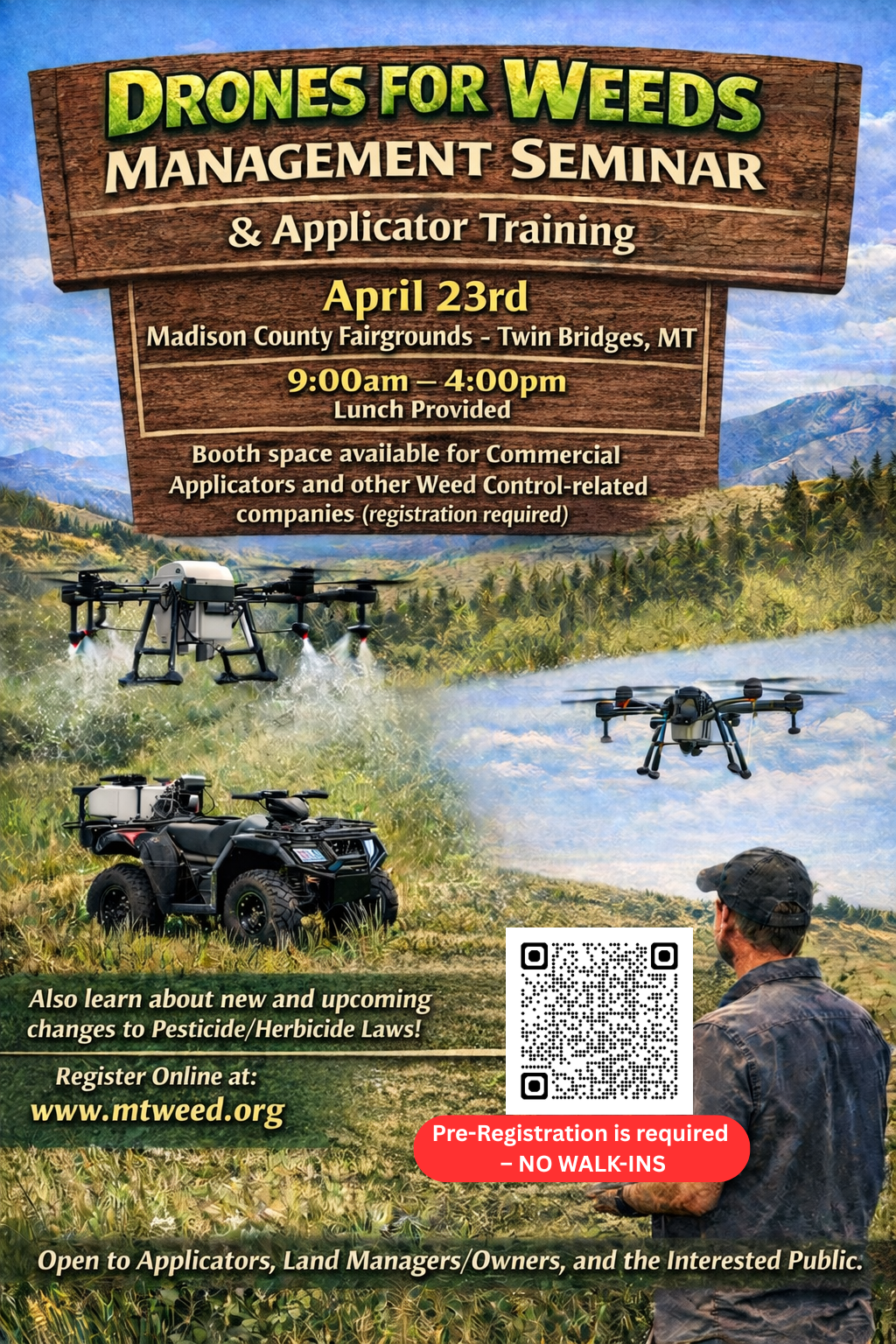
For those interested in learning more, Madison County Weed District will be hosting a “Drones for Weeds Management Seminar & Applicator Training” on April 23rd at the Madison County Fairgrounds in Twin Bridges. This event will also serve as the SW Area Spring Applicator Training for all types of ground-based Private, Commercial, and Government Applicators.
Pre-registration is required and is available through the Montana Weed Control Association at www.mtweed.org. The seminar is open to anyone interested, including all applicators, landowners, conservation groups, agency staff, and members of the public who want to better understand this emerging tool.